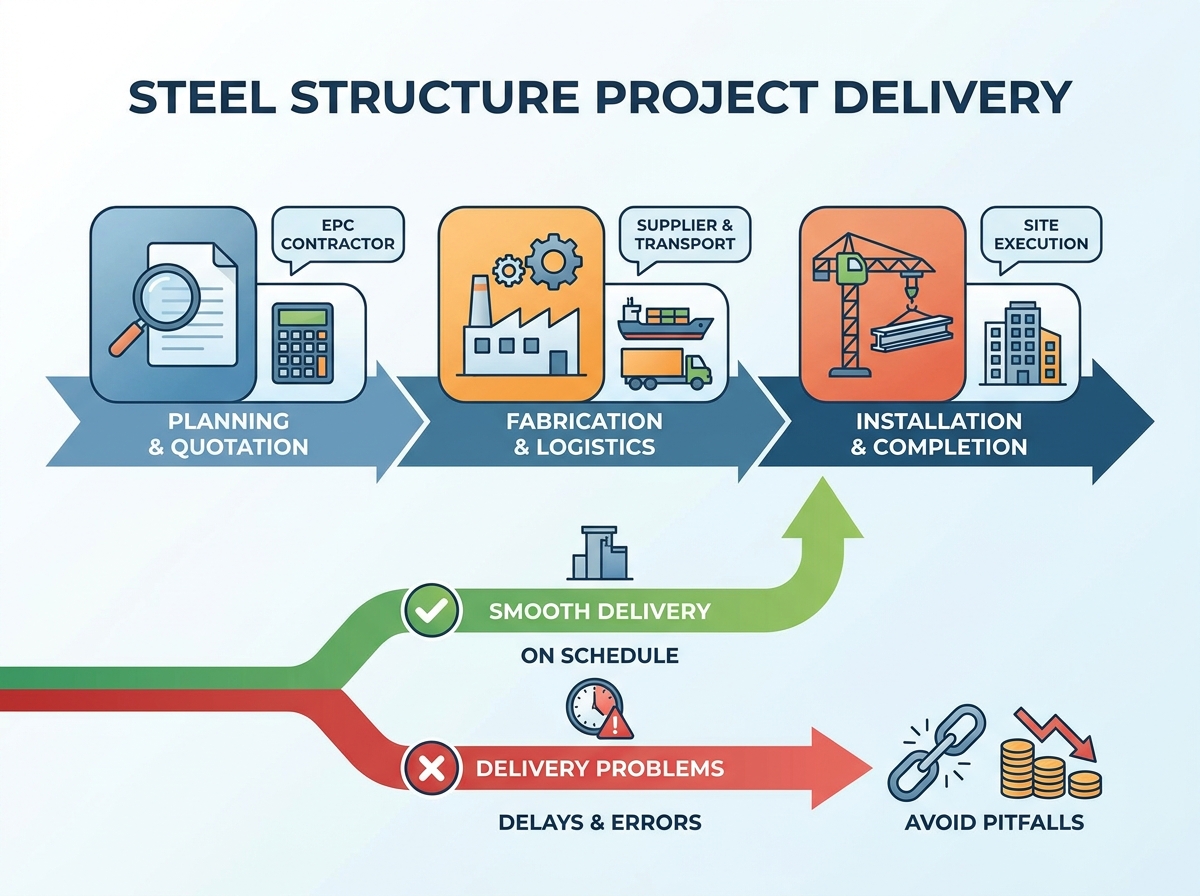
Large-scale commercial, industrial, and agricultural construction projects carry massive operational stakes. A durable steel building is only as reliable as the execution behind its procurement and assembly. Fragmented supply chains, poor site preparation, and misaligned vendor capabilities routinely lead to severe budget overruns. They also cause crippling timeline delays that ripple across every subsequent phase of construction. We designed this guide to give procurement managers and project developers an evidence-based framework. You will learn how to identify, evaluate, and neutralize the most common risks before you sign any contracts. Securing a reliable supply chain requires looking past the initial bid and auditing the entire execution strategy from factory floor to final erection. Proper planning prevents catastrophic field errors and keeps your job site moving forward.
Accurate Scoping Prevents Cost Escalation: A comprehensive steel structure project quotation must account for future scalability, complete envelope performance (insulation, vapor barriers), and site-specific engineering requirements.
Integration is Non-Negotiable: Disconnects between steel structure fabrication and installation are the primary cause of on-site rework and schedule delays.
Logistics Dictate Timelines: Proper steel structure project logistics require precise site sequencing, staging, and permitting to avoid bottlenecking the entire construction phase.
Vendor Vetting Requires Rigor: Selecting a steel structure supplier for large projects demands auditing their financial stability, production capacity, and historical adherence to delivery schedules, avoiding unverified online brokers.
The True Cost of Fragmented Project Execution
Successful execution means delivering the building on schedule, within budget, with zero safety incidents, and in exact adherence to engineering tolerances. When buyers fragment the procurement process—buying steel from one broker, hiring a separate engineering firm, and contracting an independent erection crew—they invite massive risk. A single failure in this disjointed chain destroys the entire schedule.
Consider the ripple effect of a delayed steel shipment. Foundation crews finish pouring the concrete slab, but without steel ready to erect, the site sits idle. Plumbers and electricians cannot begin their rough-ins because the building envelope does not exist. Interior build-out teams push their schedules back, often charging remobilization fees. You end up paying for empty time.
Capital expenditure risks skyrocket during these delays. Heavy equipment rentals drain budgets rapidly. A 100-ton crawler crane or a fleet of telescopic boom lifts costs a premium every single week. If these machines sit idle waiting for structural components to arrive, your contingency budget vanishes. Furthermore, delayed facility operational readiness means deferred revenue. Every week a manufacturing plant or distribution center opens late is a week of lost production and missed shipping quotas. Mastering steel structure project delivery requires treating the building as an integrated system rather than a pile of raw materials.
Interior trades cannot start rough-ins due to weather exposure.
Mismatched Bolt Holes
Erection crew stops to field-weld or re-drill.
Compromised structural integrity and ruined factory paint coatings.
Failure Point 1: Incomplete Quotations and Hidden Costs
Evaluating a bid requires looking far beyond the bottom-line price. Low initial bids often mask omitted scope, inferior materials, or missing engineering services. Buyers must evaluate features based on long-term outcomes rather than short-term savings.
Short-sighted sizing is a frequent mistake. Buyers often order a building sized strictly for their immediate operational needs to cut upfront costs. Five years later, when production demands increase, expanding that tightly engineered structure becomes exponentially more expensive. A proper steel structure project quotation should include options for expandable endwalls and load-bearing capacities that accommodate future growth.
Under-specifying the building envelope causes permanent regret. Accepting quotes that lack adequate insulation, vapor barriers, or climate-specific load ratings artificially lowers the initial bid. If your region experiences heavy snow or high seismic activity, a lighter steel frame will fail inspection or collapse. Upgrading insulation later is highly disruptive and costly.
You must scrutinize the Bill of Materials (BOM) for omitted scope and exclusions. Unscrupulous brokers often leave essential components out of the initial bid to appear competitive. Look for these commonly missing items:
Anchor bolts, leveling nuts, and base plate hardware.
Secondary framing components like purlins, girts, flange braces, and sag rods.
Exterior trim, base flashing, and commercial gutters.
Specialized coatings such as hot-dip galvanization or intumescent fire-retardant paint.
Stamped engineering drawings required for local permits.
High-strength structural bolts (A325 or A490) required for primary connections.
Raw material price volatility also impacts the final cost. Steel indexes fluctuate based on global supply chains. Understand whether you are signing a fixed-price contract or an agreement with escalation clauses. An escalation clause means you absorb the cost if steel prices spike between signing the contract and actual fabrication.
Failure Point 2: Mismanaged Schedules and Permitting
Schedule derailment usually begins long before the first piece of steel arrives on site. Implementation risks multiply when buyers misunderstand the sequence of municipal approvals and factory production queues.
Skipping or delaying local permits halts progress immediately. Many buyers assume standard building plans will easily pass local codes. Municipalities require site-specific stamped engineering drawings that account for local wind exposure categories, snow loads, and seismic design criteria. If you submit generic plans, the city will reject them. You cannot begin manufacturing until the city approves the design. Securing these permits early keeps the project moving.
Manufacturing lead times require verification. A supplier might promise a six-week delivery, but you must verify their actual production queue. Factory backlogs change daily. If your permit gets delayed by three weeks, you lose your slot in the manufacturing queue and might wait an additional two months for the next opening. Managing the steel structure project schedule means aligning permit approvals perfectly with factory production slots.
Weather and contingency planning are mandatory. Unavoidable site delays happen. Heavy rain turns job sites into mud pits, preventing heavy trucks from delivering steel. High winds force crane operators to halt erection for safety reasons. Build realistic buffer zones into your schedule to absorb these weather events without throwing subsequent trades off track.
Failure Point 3: Disconnects Between Fabrication and Installation
Using separate, uncoordinated entities for manufacturing and erection introduces massive risk. When the factory and the field crew do not communicate, the buyer pays for the resulting rework.
Factory-level quality assurance prevents on-site nightmares. Look for fabricators with strict internal quality control standards. If a factory drills bolt holes a quarter-inch off center, the erection crew cannot assemble the beams. Field welding or torching new holes on site compromises the structural integrity and destroys the protective paint coating. Precise steel structure fabrication and installation relies on exact factory tolerances mapping perfectly to field assembly.
Site preparation failures directly sabotage the installation phase. Erection crews rely on the foundation contractor to place anchor bolts with millimeter precision using rigid templates. If the foundation is poured incorrectly, or the site is unlevel, the steel will not fit. Poor soil compaction in the staging area causes heavy lifting equipment to sink. These site failures halt erection crews, incur standby charges, and often void manufacturer warranties.
Handoff protocols require strict documentation. When the fabrication team ships the components, they must provide detailed erection drawings and part manifests. The on-site crew needs a clear communication framework to report missing hardware or damaged panels immediately. Without this protocol, crews waste days sorting through disorganized steel piles trying to identify specific columns.
Failure Point 4: Overlooking Logistics and Site Sequencing
Logistics management directly impacts project velocity and overall lifecycle costs. Moving massive structural steel members across the country and staging them on a crowded job site requires precise orchestration.
Transportation of oversized loads involves heavy regulation. Large clear-span trusses and massive primary columns do not fit on standard flatbed trailers. They require step-deck trailers, specialized freight routing, escort vehicles, and oversized load permits. Failing to secure these permits delays shipping and incurs heavy fines.
Site staging and storage present significant risks. Delivering materials too early causes severe site congestion. If steel sits on the ground for months exposed to rain and mud, it develops rust and requires field touch-ups. Conversely, delivering materials too late leaves your expensive labor force standing idle. Proper steel structure project logistics balance these two extremes.
Just-In-Time (JIT) delivery sequencing solves this problem. Components must arrive in the exact order of erection to minimize double-handling. Moving a three-ton steel beam twice because it was unloaded in the wrong spot wastes crane time and labor hours. A proper sequence looks like this:
Anchor bolts and base plates arrive first for foundation embedding.
Primary framing (columns and rafters) arrives for main structural erection.
Secondary framing (purlins, girts) arrives to tie the main frame together.
Wall cladding, roof panels, and insulation arrive last to enclose the building.
Site Staging Best Practices
Staging Element
Execution Standard
Shake-Out Area
Designate a flat, compacted zone specifically for sorting and inspecting steel upon arrival.
Dunnage Usage
Store all steel members on wooden dunnage to prevent direct contact with mud and standing water.
Crane Positioning
Stage heavy primary columns within the immediate swing radius of the crane to avoid secondary lifting.
Failure Point 5: Choosing the Wrong Supplier for Large Projects
Auditing potential suppliers requires a strict framework based on scalability and compliance. A vendor who successfully delivers small backyard garages is rarely equipped to handle a 100,000-square-foot industrial warehouse.
Avoid the trap of unverified online vendors. Many buyers source large commercial projects from social media ads or unvetted brokers. These brokers rarely have in-house engineering or fabrication capabilities. They simply act as middlemen, marking up prices and passing the liability down the chain. When a component fails or goes missing, the broker disappears.
You must differentiate between theoretical capacity and actual capability. A supplier might have the engineering software to design a large building, but do they have the factory throughput to deliver it on time? Ask for their monthly tonnage capacity and inspect their CNC beam drill lines. A reliable steel structure supplier for large projects will transparently share their production metrics and current backlog.
Financial stability is another critical evaluation dimension. If a supplier declares bankruptcy mid-project, you lose your deposit and your building. Require performance bonds or request financial disclosures before signing large contracts. Check their track record by calling past clients. Do not just ask if the building looks good. Ask how the supplier handled change orders, missing parts, and warranty claims.
Mitigating Risk: The Role of an EPC Contractor
The Engineering, Procurement, and Construction (EPC) model offers a robust solution for high-stakes developments. Instead of juggling multiple contracts, the buyer hires one entity to handle the entire lifecycle of the building.
Single-source accountability eliminates the blame game. In a fragmented model, if a beam does not fit, the engineer blames the fabricator, the fabricator blames the erector, and the erector blames the foundation crew. An EPC steel structure contractor absorbs all that risk. If something goes wrong, they fix it on their own dime because they control the entire process.
Value engineering happens early in the EPC model. Because the engineers and fabricators work for the same company, they collaborate during the conceptual phase. They identify cost-saving design modifications—like optimizing bay spacing or standardizing member sizes—without sacrificing structural integrity. This integration reduces waste and speeds up production.
Project Delivery Model Comparison
Delivery Model
Accountability
Communication Flow
Risk Profile for Buyer
Fragmented (Traditional)
Divided among multiple independent vendors.
Siloed. Buyer acts as the middleman.
High. Buyer absorbs costs of miscommunication and delays.
Integrated EPC
Single-source accountability.
Seamless internal communication.
Low. Contractor absorbs execution risks.
Acknowledge the conceptual trade-offs. EPC contracts often present a higher initial upfront cost compared to scraping together the lowest bids from independent brokers. However, they offer absolute cost certainty. The price you sign for is the price you pay, shielding you from change orders and schedule overruns.
Conclusion
Audit your current project scope to verify it includes future scalability options and complete building envelope specifications.
Demand a detailed logistical plan from shortlisted vendors that explicitly outlines JIT delivery sequencing and freight routing.
Require structural engineering drawings stamped by a professional engineer licensed in your specific state or municipality before authorizing fabrication.
Transition to an integrated EPC model for high-stakes, large-span developments to guarantee single-source accountability and eliminate vendor disputes.
FAQ
Q: What should be included in a comprehensive steel structure project quotation?
A: A complete quotation must include a detailed Bill of Materials (BOM), stamped engineering drawings, freight costs, and all necessary hardware like anchor bolts. It should clearly outline building envelope specifications, including insulation and vapor barriers, and explicitly list any exclusions to prevent hidden costs.
Q: How long does a typical steel structure project schedule take?
A: Timelines vary by project size. Engineering and permitting typically take 4 to 8 weeks. Fabrication requires another 6 to 10 weeks, depending on factory backlogs. On-site erection for a standard commercial building usually takes 3 to 6 weeks. Always build weather buffers into this schedule.
Q: What are the biggest risks during steel structure fabrication and installation?
A: The primary risks include tolerance mismatches where factory-drilled holes do not align on site, poor site preparation by foundation crews, and a lack of communication between the manufacturer and the erection team. These issues lead to severe rework, compromised structural integrity, and extended delays.
Q: Why is site sequencing critical for steel structure project logistics?
A: Site sequencing prevents site congestion and minimizes double-handling of heavy materials. Just-In-Time (JIT) delivery ensures components arrive exactly when needed—columns first, followed by secondary framing and cladding—keeping labor productive and tight job sites organized.
Q: What is the advantage of hiring an EPC steel structure contractor?
A: An EPC contractor provides single-point accountability for engineering, procurement, and construction. This eliminates the blame game between separate vendors, streamlines communication, allows for early value engineering, and drastically reduces the risk of expensive change orders.
Q: How do I evaluate a steel structure supplier for large projects?
A: Evaluate suppliers based on their actual factory production capacity, detailing software capabilities, and financial health. Check references to see how they handle warranty claims and change orders. Always avoid unverified online brokers who lack in-house engineering capabilities.
Q: Can poor site preparation affect the delivery of my steel building?
A: Yes. If the foundation is poured incorrectly, anchor bolts are misaligned, or the site is unlevel, the steel components will not fit together. This halts the entire erection process, incurs heavy equipment standby fees, and can void the manufacturer's warranty.
A comprehensive steel structure company integrating processing design, installation, and technical services.
About Lianfang
Is a comprehensive steel structure company integrating processing design, installation and technical services of grids, steel structures, pipe trusses and spherical grids.