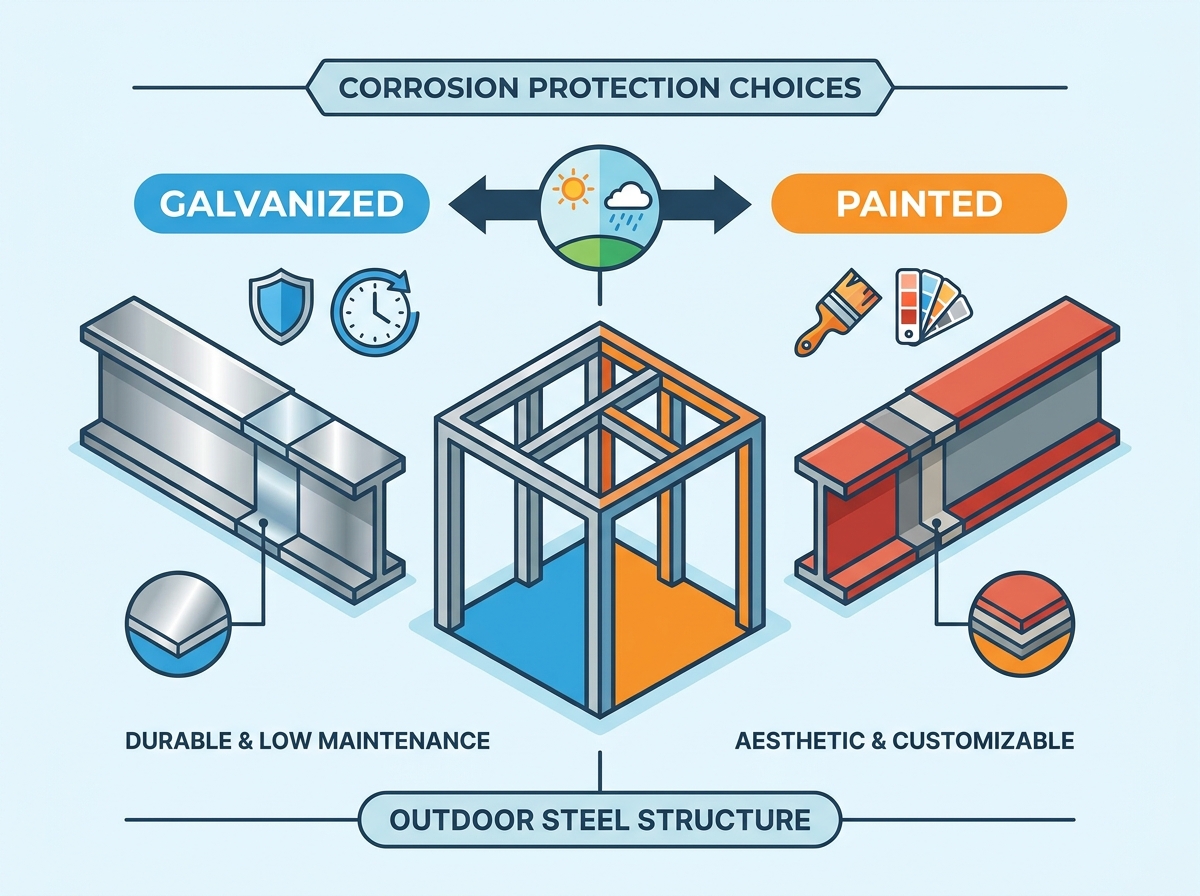
Outdoor steel structures face relentless environmental degradation from moisture, chlorides, and industrial pollutants. Without rigorous protection, structural integrity compromises lead to catastrophic safety hazards and compounding remediation efforts. Specifying the wrong anti-corrosion system accelerates degradation. It forces premature asset retirement and increases maintenance downtime. This is particularly true in aggressive environments like coastal, industrial, and high-humidity zones where steel rapidly oxidizes. We see projects fail early because designers underestimate the local atmospheric corrosivity or select incompatible primer and topcoat combinations. This guide provides a technical framework for engineers and project managers. You will learn to evaluate, shortlist, and specify optimal corrosion protection steel structure methodologies based on environmental exposure, structural geometry, and project lifespan.
Key Takeaways
Environmental Baseline: The ISO 12944 environmental classification (C1 through C5-M/C5-I) must dictate the baseline requirements for any outdoor steel structure corrosion protection strategy.
Lifecycle Cost vs. Upfront Spend: Initial application savings often mask long-term liabilities; a cheaper painted steel structure coating typically yields higher lifecycle costs due to frequent maintenance and recoating cycles compared to hot-dip galvanizing.
System Compatibility: Combining dissimilar metals or applying incorrect topcoats over zinc primers leads to rapid galvanic or adhesive failure, requiring strict adherence to manufacturer and engineering specifications.
Supply Chain Integration: Partnering with an experienced galvanized steel structure supplier or specialized coating applicator early in the design phase mitigates implementation risks, ensures QA/QC compliance, and validates warranty parameters.
Defining Success Criteria for Outdoor Steel Structure Corrosion Protection
Environmental Exposure and Corrosivity Categories (ISO 12944)
Assessing macro-environmental atmospheric conditions is the first step in protecting structural assets. You must classify the site accurately before selecting any materials. The ISO 12944 standard provides a reliable framework for this classification. Categories range from C1 for benign interiors to C5-I for heavy industrial zones. C5-M covers highly aggressive marine and seawater environments. Properly classifying the site ensures the selected outdoor steel structure corrosion protection system matches the actual threat level.
Micro-climates also demand careful evaluation. A general regional classification often misses localized hazards that destroy coatings prematurely. You must evaluate specific site conditions during the planning phase.
Localized chemical exposure from nearby exhaust vents or cooling towers.
Industrial emissions and particulate matter settling on horizontal structural surfaces.
Coastal salt spray carried by prevailing winds miles inland from the shoreline.
Intense UV degradation in high-altitude or equatorial locations that chalks epoxies.
Constant dampness in shaded areas surrounded by dense vegetation or adjacent buildings.
To illustrate how ISO 12944 dictates material selection, consider the expected mass loss of low-carbon steel in different environments. In a C2 environment, steel might lose 10 to 100 grams per square meter annually. In a C5-M environment, that loss jumps to 400 to 650 grams. You cannot use a C2 coating system in a C5 environment and expect it to last.
ISO 12944 Category
Corrosivity Level
Typical Outdoor Environment
Typical Indoor Environment
C1
Very Low
Not applicable
Heated buildings with clean atmospheres.
C2
Low
Atmospheres with low pollution. Mostly rural areas.
Unheated buildings where condensation may occur.
C3
Medium
Urban and industrial atmospheres, moderate sulfur dioxide pollution.
Production rooms with high humidity and some air pollution.
C4
High
Industrial areas and coastal areas with moderate salinity.
Chemical plants, swimming pools, coastal ship and boatyards.
C5-I
Very High (Industrial)
Industrial areas with high humidity and aggressive atmosphere.
Buildings or areas with almost permanent condensation and high pollution.
C5-M
Very High (Marine)
Coastal and offshore areas with high salinity.
Buildings or areas with almost permanent condensation and high pollution.
Design Life and Maintenance Accessibility
Durability expectations must align with the asset's intended lifecycle. Differentiate between short-term, medium-term, and long-term requirements. Short-term protection spans 5 to 15 years. Medium-term covers 15 to 25 years. Long-term durability exceeds 25 years. A temporary support structure requires different specifications than a permanent highway overpass. Matching the coating system to the design life prevents over-engineering and under-protection.
Future maintenance accessibility dictates initial system selection. An outdoor space frame corrosion resistance strategy must account for complex geometries. Hard-to-reach nodes, bolted connections, and high-elevation joints make manual recoating physically unviable. If a structural element cannot be easily accessed with scaffolding or aerial lifts, it requires a maintenance-free system from day one. You cannot rely on manual touch-ups for components suspended 100 feet in the air over active machinery.
Core Anti-Corrosion Systems: Technical Evaluation and Trade-offs
Hot-Dip Galvanizing (HDG)
Hot-dip galvanizing creates a metallurgical zinc-iron alloy bond between zinc and steel. This provides both durable barrier protection and cathodic protection. If the coating scratches, the surrounding zinc sacrifices itself to protect the exposed steel. This dual mechanism makes HDG incredibly resilient against mechanical damage during transport and erection. The process involves dipping fabricated steel into a kettle of molten zinc at approximately 840 degrees Fahrenheit. The resulting coating consists of several distinct alloy layers (Gamma, Delta, Zeta) topped with a layer of pure zinc (Eta).
Raw steel chemistry directly impacts galvanizing quality. You must evaluate the steel composition before specification. Silicon and phosphorus levels are particularly critical. They must fall outside the Sandelin and Sebisty ranges. Ignoring these ranges causes excessive zinc-iron alloy growth. This results in brittle, overly thick coatings that easily flake off when struck. We always request mill test reports to verify silicon content before sending steel to the galvanizer.
HDG excels in high-abrasion areas. It easily coats complex internal and external hollow geometries, provided the fabricator includes proper venting and draining holes. It is the ideal choice for projects requiring long-term, zero-maintenance durability. The zinc coats the inside of tubular sections just as effectively as the outside, preventing internal corrosion that goes unnoticed until structural failure occurs.
However, HDG has physical constraints. It is limited by the physical size of the galvanized steel structure supplier's galvanizing baths. If a beam exceeds the kettle length, it requires progressive dipping, which can leave a visible seam and increase the risk of distortion. Initial aesthetic options are also limited to a standard metallic finish. You can utilize duplex-coated systems for architectural color requirements, applying paint over the galvanized surface after proper profiling.
High-Performance Protective Coatings (Liquid and Powder Paint)
Liquid and powder paints deliver engineered protection utilizing multi-coat systems. Each layer performs a specific function. You cannot rely on a single coat of paint for outdoor structural steel. A proper system builds thickness and redundancy.
Zinc-Rich Primer: Provides primary cathodic corrosion protection at the steel interface. Inorganic zinc silicates offer excellent performance but require strict humidity controls during curing. Organic zinc epoxies are more forgiving during application.
Epoxy Intermediate Build Coat: Acts as a high-durability barrier layer to block water, oxygen, and chemical ingress. This layer builds the necessary dry film thickness (DFT) to isolate the primer from the environment.
Polyurethane/Urethane Topcoat: Protects the system against UV degradation and atmospheric weathering while delivering aesthetic requirements. Epoxies chalk and fade in sunlight, making the urethane topcoat mandatory for outdoor exposure.
These systems are best for highly specific architectural color matches. They handle aggressive chemical or acidic exposures well when formulated correctly. They also suit large-scale structural assemblies requiring on-site application or touch-ups. When a component is too large for a galvanizing kettle, a high-performance liquid coating system applied in a climate-controlled shop is the standard alternative.
A painted steel structure coating is highly susceptible to mechanical damage during transport and erection. Chains, nylon straps, and impact from other beams easily chip the paint down to the bare steel. It demands strict surface preparation to SSPC/NACE standards. It also necessitates ongoing, scheduled maintenance cycles to remain effective. You must plan for touch-up painting immediately after erection to repair handling damage.
Uncoated Weathering Steel (UWS)
Weathering steel utilizes specific copper, phosphorus, and chromium alloy compositions. These elements form a stable, tightly adhering rust-like protective patina. This patina resists further atmospheric corrosion without additional coatings. The initial oxidation layer acts as a barrier, slowing down the corrosion rate to a fraction of what standard carbon steel experiences.
UWS is best for highway bridges and remote infrastructure. It performs exceptionally well in environments with consistent, alternating wet and dry atmospheric cycles. The patina requires these cycles to stabilize properly. If the steel remains constantly wet, the protective layer never forms, and the steel corrodes just like standard carbon steel.
Trade-offs limit its application. UWS is unsuitable for constant moisture, marine salt spray, or submerged environments. Heavy chloride exposure destroys the protective patina, causing rapid section loss. It also requires specific architectural detailing. You must prevent rust-wash runoff staining on adjacent concrete and materials. We always design drip pans or divert runoff water away from substructures when using weathering steel.
Thermal Sprayed Coatings (Metallizing)
Metallizing involves melting and spraying zinc, aluminum, or zinc-aluminum alloys. Applicators spray the molten metal directly onto a grit-blasted steel surface using wire arc or flame spray equipment. This forms an impermeable protective barrier that offers excellent cathodic protection. The coating thickness can be built up significantly higher than hot-dip galvanizing.
This method is best for extremely large structural members. It easily handles components too large for HDG baths. It excels in marine splash zones and assets exposed to aggressive offshore environments requiring long-term protection. We frequently specify metallizing for bridge girders and offshore platform components.
The process requires highly skilled applicators and rigorous surface profiling. The steel must be blasted to a sharp, angular profile to ensure mechanical adhesion. The sprayed coating is inherently porous and must be sealed with a low-viscosity sealer coat. This prevents moisture from penetrating the pores and extends the system's lifespan.
Scalability, Logistics, and Supply Chain
Supplier Capacity and Quality Control
Assessing supplier capacity and quality control prevents project delays. You must vet your suppliers thoroughly. Check for ISO 9001 compliance and adherence to ASTM or EN standards. Verify the dimensions of the galvanizing baths or paint booths to ensure they can handle your largest structural members. A mismatch here forces costly redesigns or field splicing.
Turnaround times fluctuate based on shop capacity. Secure production slots early in the project schedule. Request documentation of their internal quality assurance processes. We require daily logs of ambient conditions, surface profile measurements, and dry film thickness readings from our coating applicators.
Transportation and Handling Logistics
Evaluating lead times and transportation logistics is critical for pre-coated structural members. Moving massive steel beams without damaging the protective coating requires specialized handling. You cannot use standard steel chains. Mandate the use of soft nylon slings and padded blocking during loading and unloading.
Transit damage is inevitable, but you can minimize it. Plan the logistics route to avoid low bridges or tight turns that require excessive handling. For site-applied coating systems, factor in the time required to erect environmental containment structures. Field painting requires scaffolding, tarps, and climate control equipment to maintain the required application parameters.
Implementation Risks and Engineering Mitigation Strategies
Design-Phase Vulnerabilities and Geometry
Corrosion protection begins on the drafting table. Detailing must prevent corrosion traps. Avoid crevices where moisture and debris accumulate. Ensure proper drainage patterns to eliminate standing water and ponding. Reduce direct atmospheric exposure of critical joints whenever possible. We slope horizontal stiffeners slightly to ensure water runs off rather than pooling.
Mitigating galvanic corrosion is crucial for any anti corrosion steel frame project. Isolate dissimilar metals using non-conductive elastomeric gaskets, washers, and sleeves. Direct contact between carbon steel and stainless steel or aluminum accelerates degradation rapidly in the presence of an electrolyte like rainwater.
Specify proper edge rounding. A minimum 2mm radius is standard. Sharp edges cause liquid paint systems to pull away during curing due to surface tension. This leads to edge-retention failures and premature rusting. Grinding all sharp edges before abrasive blasting is a mandatory step in our specifications.
Design Flaw
Corrosion Consequence
Engineering Mitigation
Sharp cut edges
Paint pulls away, leaving thin coverage and early rust.
Grind edges to a minimum 2mm radius before blasting.
Flat horizontal surfaces
Water and debris ponding, accelerating coating breakdown.
Design with a slight slope or add drainage holes.
Skip welds / Intermittent welds
Moisture enters the crevice between welded parts.
Specify continuous seal welds for all outdoor exposures.
Abrasive blasting plays a critical role in coating success. Standards like Sa 2.5 or SSPC-SP 10 "Near-White Metal" establish the necessary anchor profile. This profile provides the mechanical adhesion required for primers to bond effectively. If the profile is too shallow, the paint peels. If it is too deep, the peaks of the steel profile protrude through the primer, causing pinpoint rusting.
Monitoring micro-environmental application parameters prevents hidden failures. Enforce strict limits on dew point, relative humidity, substrate temperature, and ambient temperature during the coating process. The steel surface temperature must remain at least 5 degrees Fahrenheit above the dew point. Applying epoxy over a microscopic layer of condensation guarantees delamination.
Mandate third-party NACE/AMPP certified inspectors. They verify surface profile, dry film thickness (DFT), and cross-hatch adhesion. Independent verification ensures the system performs exactly as specified. We never rely solely on the applicator's internal quality control reports for critical infrastructure projects.
Conclusion
To ensure structural longevity and minimize environmental degradation, follow these precise next steps:
Conduct a site-specific corrosivity assessment using the ISO 12944 framework before finalizing any structural designs.
Select hot-dip galvanizing as the default baseline for structural members, reserving multi-coat systems for specific aesthetic or chemical requirements.
Review all structural detailing to eliminate water traps, sharp edges, and direct contact between dissimilar metals.
Draft stringent technical specifications that mandate specific surface preparation profiles and environmental application limits.
Engage third-party certified inspectors to verify dry film thickness and adhesion during the application phase.
FAQ
Q: What is the most durable corrosion protection for outdoor steel structures?
A: Hot-dip galvanizing and thermal sprayed coatings generally provide the highest durability. They offer both barrier and cathodic protection. Their lifespan often exceeds 50 years in moderate environments without requiring active maintenance.
Q: How does the ISO 12944 standard impact steel coating selection?
A: ISO 12944 classifies environmental corrosivity from C1 (very low) to C5 (very high). It dictates the required coating thickness, primer type, and surface preparation needed to achieve a specific design life in that exact environment.
Q: What is the difference between barrier protection and cathodic protection in steel?
A: Barrier protection physically blocks water and oxygen from reaching the steel substrate. Cathodic protection uses a sacrificial metal, like zinc, which corrodes preferentially to protect the underlying steel even if the barrier is scratched.
Q: Can you apply a painted steel structure coating over hot-dip galvanizing?
A: Yes. This is called a duplex system. It requires specific surface preparation, usually a light sweep blast, to profile the zinc surface. You must then apply compatible primers and topcoats to ensure proper adhesion.
Q: Why do protective coatings fail prematurely on outdoor steel?
A: Premature failure almost always stems from inadequate surface preparation. Failing to remove mill scale, applying coatings over condensation, or ignoring sharp edges prevents proper mechanical adhesion, leading to rapid delamination and rust creep.
Q: When should weathering steel be avoided in construction projects?
A: Avoid weathering steel in environments with constant moisture, heavy marine salt spray, or high chloride exposure. The steel requires alternating wet and dry cycles to form its protective patina; without them, it will corrode continuously.
A comprehensive steel structure company integrating processing design, installation, and technical services.
About Lianfang
Is a comprehensive steel structure company integrating processing design, installation and technical services of grids, steel structures, pipe trusses and spherical grids.